
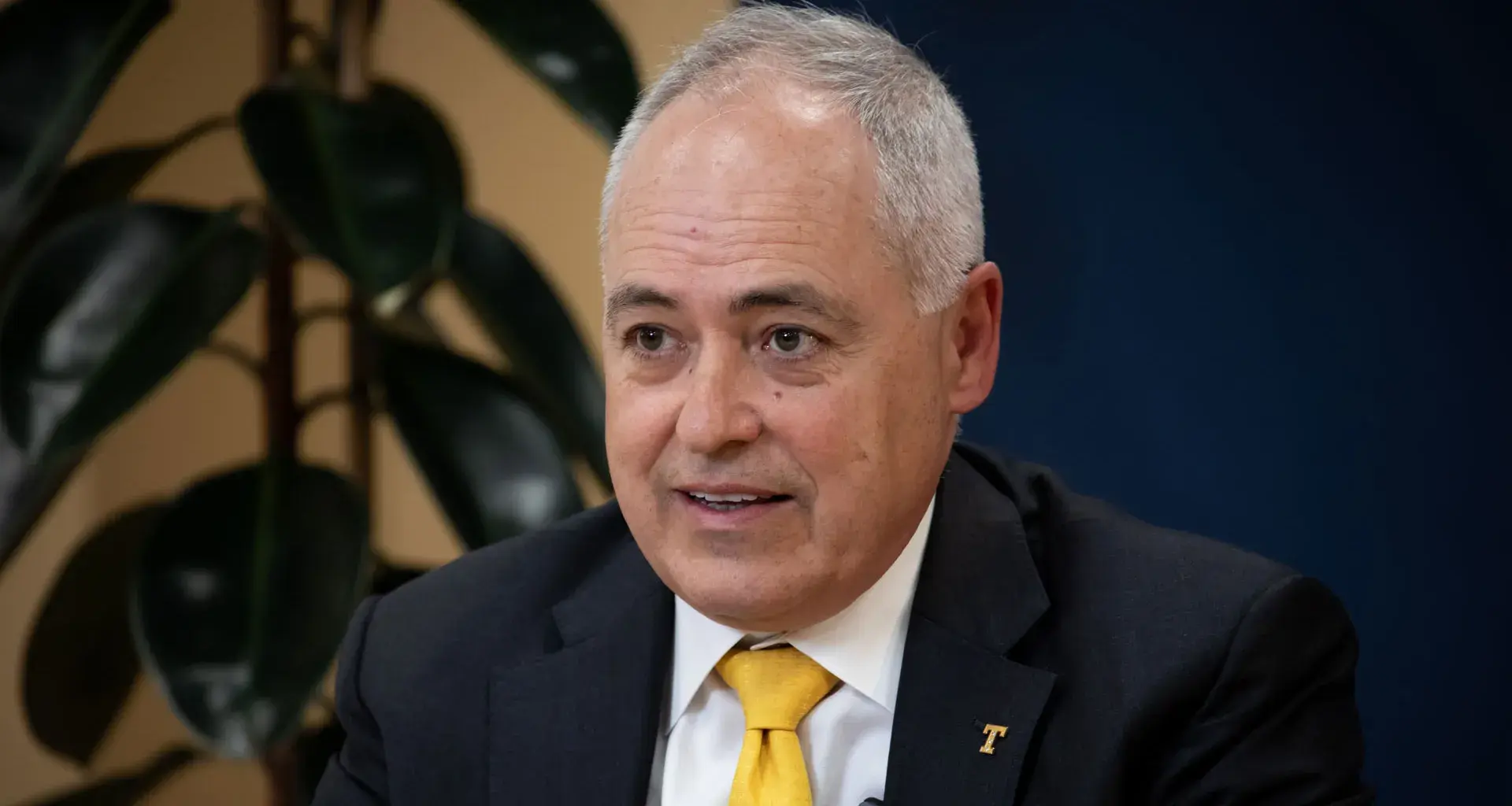

According to Ángel Cabrera, universities must lead innovation and train graduates for a world with AI
Artificial intelligence (AI) has already transformed the jobs universities were training their students for. This is not a future projection. It is a change that has already occurred.
These were the words of Ángel Cabrera, President of the Georgia Institute of Technology, during his visit to the 2026 Board Meeting.
According to Cabrera, universities cannot limit themselves to reacting to their environment. Rather, they must take the lead in training talent, bringing together stakeholders, and building innovation ecosystems, even when this means changing traditional practices.
An environment that changes faster than curricula
In an interview with CONECTA, Cabrera explained that one of the constants in recent years has been the acceleration of technological change, particularly with AI.
Unlike previous innovations, its adoption has been faster and its impact more profound.
“The speed at which people have adopted artificial intelligence is far greater than the speed at which the internet was adopted.”
That pace, he explained, is simultaneously transforming universities and businesses.
“The interesting thing is that the solutions we need aren’t necessarily technological.” – Ángel Cabrera
The most immediate effect is seen in the labor market.
“Jobs that were available to our graduates five years ago no longer exist.”
In areas such as computer science, the initial position was to program, code, and perform technical tasks within a team.
That initial job no longer exists.
The direct consequence is that universities can no longer train students to perform functions that have been absorbed by AI tools, he said.

What do humans contribute when technology already knows how to do everything?
Faced with this scenario, Cabrera believes that the problem is not technology itself but rather the redefinition of human value.
If artificial intelligence can program, write essays, design objects, analyze data, or generate proposals in minutes, the central question is what is left for people to do.
“The interesting thing is that the solutions we need aren’t necessarily technological.”
What becomes valuable, he said, are skills that cannot be easily automated: “Knowing what questions to ask, knowing how to analyze answers critically, and having moral judgment and value judgment.”
According to Cabrera, the following are some of the key human skills:
- Knowing how to ask the right questions
- Analyzing responses critically
- Critical judgment
- Moral judgment
- Value judgment
- Critical thinking
- Moral thinking
- Strategic thinking
- Ability to understand the social context
- Ability to understand the world
- Leadership
- Communication
- Persuasion
- Teamwork
- Ability to resolve conflicts as a team
- Ability to interact with others
- Ability to sell ideas
- Ability to persuade others (customers, teams, organizations)
- Ability to make decisions in complex contexts
- Ability to evaluate solutions proposed by artificial intelligence
“All of these skills are non-technological. They’re critical thinking skills, moral thinking skills, skills for understanding the world, and skills for relating to other people.”
From his perspective, the AI revolution is forcing technological universities to strengthen areas that historically had not been their main focus.

Rethinking the learning experience
That change, according to Cabrera, cannot be resolved by prohibiting the use of artificial intelligence in the classroom.
On the contrary, doing so would mean ignoring a tool that is already part of the professional environment.
Instead, Ángel proposed a shift in the educational approach: evaluating processes, decisions, and reasoning.
“Instead of resisting, of saying ‘no,’ what we need to do is embrace artificial intelligence as a natural tool that’s already available to everyone.”
“It’s up to universities to take the lead in building an environment of innovation.” – Ángel Cabrera
Change involves rethinking the objective of each academic program and designing experiences that raise students’ cognitive level rather than competing against technology which already performs basic tasks better than any person can, he explained.
He mentioned some cases in which teachers ask students not only for the final result, but also to “check your prompts, review all the questions you’ve asked, and examine your thinking,” in order to evaluate the reasoning process and decision-making.
Following this logic, the focus is no longer on whether the tool generates a correct answer, but rather on “what questions you ask, how you analyze the answers, and how that helps you create something far superior.”
He also explained that these types of transformations need to be carried out with collaboration between universities, particularly in order to foster a global mindset.
“There are many things that a university alone cannot do, such as ensuring constant interaction with people from other cultures.”

The university and its responsibility to the environment
The world’s most dynamic economies are built around large research universities. This was the idea that Cabrera started with during his talk at the 2026 Board Meeting.
“The future of the global economy will be shaped by cities that are able to attract the best talent in the world.”
According to Ángel: “There’s no other option but to build these cities around large academic institutions.”
Based on his experience at the Georgia Institute of Technology, he decided to explicitly take on that role. He defined strategic goals committed to growing research, increasing the number of graduates, and translating that knowledge into economic and social impact.
“The bottom line is that it’s up to the university to take the lead in building an environment of innovation. There’s no other option.”
That leadership, he explained, involves coordinating companies, creating infrastructure, prioritizing the commercialization of research, and generating networks to support entrepreneurship. This is not as an isolated effort but as a sustained strategy.
In this context, he highlighted the role of the Education Group’s board members and business leaders. “No one knows better what a city needs than the business leaders of that city.”

About Ángel Cabrera
Ángel Cabrera is the 12th President of the Georgia Institute of Technology, one of the most important technological and research universities in the United States.
He holds a master’s degree and doctorate in Psychology and Cognitive Science from Georgia Tech, an undergraduate degree and master’s degree in Electrical and Computer Engineering from the Polytechnic University of Madrid, and is a former Fulbright scholar.
Cabrera is the first Spanish-born president of an American university.
Before assuming the presidency of Georgia Tech, Ángel was President of George Mason University, the Thunderbird School of Global Management, and Dean of EADA Business School.
Throughout his tenure at Georgia Tech, he has promoted the strengthening of research, positioning the institution among the 20 universities with the highest research intensity in the United States and number 1 among those without a medical school.
He has also promoted the transformation of the urban environment surrounding the campus, with the aim of consolidating it as an ecosystem of innovation, entrepreneurship, and collaboration with industry.
Cabrera is co-author of Principles for Responsible Management Education, co-founder of the Global University Leaders Coalition, has been recognized as a Young Global Leader by the World Economic Forum, and has served as an advisor to institutions such as the National Geographic Society and the Harvard College Visiting Committee.

2026 Board Meeting
The “Plan in Action” Board Meeting discussed the lines of action of the Tecnológico de Monterrey Education Group’s strategic initiatives.
This event featured April Rinne, futurist, best-selling author, and advocate for humanity; and Ángel Cabrera, 12th President of the Georgia Institute of Technology.
Also present were Pablo Legorreta, Founder, CEO, and Chairman of Royalty Pharma; and Professor Mathias Uhlén, professor at the Royal Institute of Technology (KTH) in Stockholm, Sweden.
Prior to this meeting, the Annual General Meeting was held, which reviewed the results and progress of 2025.
“Your individual commitment and dedication are a source of inspiration and a pillar for continuing to build a bright future,” said Ricardo Saldívar, Chairman of the Board of the Tecnológico de Monterrey Education Group.
IF YOU FOUND THIS CONTENT INTERESTING, YOU MAY ALSO LIKE:
Seleccionar notas relacionadas automáticamente
1
Category:
Related stories


